Background: Newmarket’s library board meets tomorrow Wednesday when they will look again at library statistics. They say they want to “measure what matters”. 
The previous CEO, Todd Kyle, warned us over a decade ago that that the library was no longer fit for purpose and a new building was needed. I agree. Unfortunately, a new library is not even an aspiration for the Board. It wants to squeeze as much as it can out of the existing inadequate Park Avenue building.
The recent rebrand “Anywhere and Everything” focusses on outreach, going out into the community, targeting schools to sign up new “active” members. But what exactly is an “active” member?
Key Definition Changed
The Province has just changed a key definition used by libraries across Ontario to report their membership numbers – or “active cardholders”. Libraries must file this figure with the Province by 30 April 2026 for inclusion in the Annual Survey of Public Libraries (ASPL), a statistical series going back years.
Errors and revisions were often left uncorrected in the ASPL even though the series is relied on by the public and regarded - mistakenly - as authoritative.
The Ministry’s old definition of “active cardholder” lacked clarity and was open to different interpretations. Previously, we were told “active” cardholders were:
“cardholders who have used their library card in the past two years”
Many libraries across Ontario, relying on common English usage and the plain meaning of words, counted library members who had actually used their card to access library services.
But in a January 2026 revision the Province told us an “active” cardholder would, in future, be a library member who has:
“used, activated, or renewed their library card in the past two years”
This means the Province now wants a bald headcount rather than a figure showing the number of people who use their card to access library services beyond mere activation.
Interpretation
At the turn of the year, I filed Freedom of Information requests with over 30 Ontario libraries asking how they interpreted the then definition of “active cardholder”. I asked for any documents, memos or guidance to staff explaining how active cardholders were identified and counted. (Click “read more” below)
A handful of libraries, such as St Thomas, equated “active cardholders” with library members with an unexpired library card.
Others, such as Quinte West Public Library in Trenton, took a very different approach: 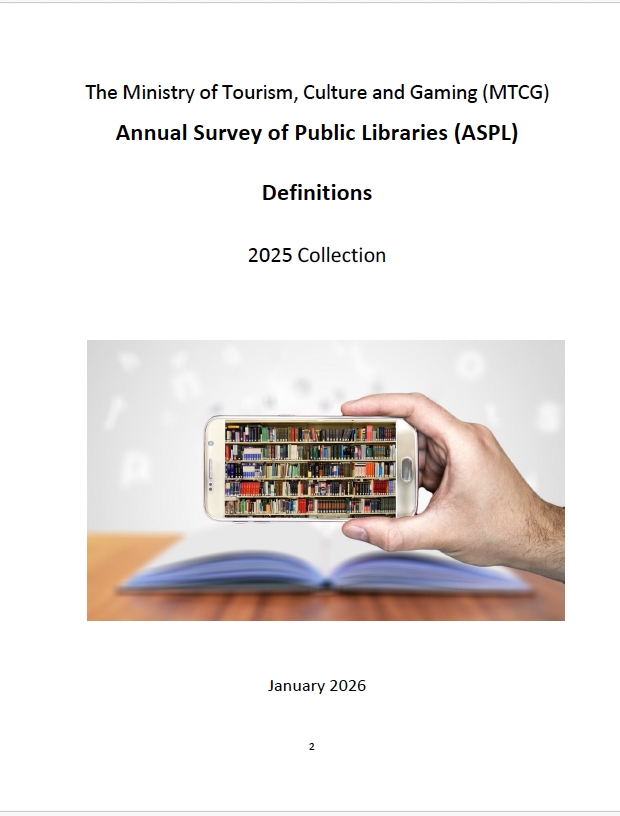
“This (active cardholder) metric is used to measure the actual usage of the library by registered patrons, rather than just the number of people who hold an unexpired card.
This provincial definition is a standardized metric used across Ontario to ensure consistent and comparable data for library statistics.”
It is common ground throughout the library world that the definition didn’t capture everything that libraries offered. Guelph Public Library put it this way:
“We acknowledge for contextual understanding that members of the public may interact with the library without using a library card (for example, by using public access computers, attending programs, or using library space as warming or cooling centres).
These interactions are not included in the Active Cardholder count as they fall outside the Ministry’s definition.”
Whatever its other merits, the Annual Survey’s old definition did not ensure consistent and comparable data across Ontario’s libraries.
Newmarket’s membership up 26%
The number of “active cardholders” is often used by libraries as a key metric to show their local communities how well they are doing.
So, it comes as no surprise that Newmarket Library’s latest “Report to the Community” breathlessly tells us that in 2025:
“library membership grew by an impressive 26%”
bringing the total number of members to 28,005 – the highest year end figure since the series of on-line records began in 2014.
Over the past two years membership has soared by an eye-watering 47.7%
They do this by defining an “active” member as someone with an unexpired library card – whether they use the card to access any Library services or not.
Why is this important?
Newmarket library’s priority is to bulk up its membership. When new members are signed up through outreach their membership card is automatically activated, there and then, before they have a chance to use it.
The Library does not track these new members to see if they ever use their library card. The CEO says there are privacy considerations. But legislation specifically allows for this information, aggregated and anonymized, to be collected for statistical purposes.
Figures reported to the Library Board on 19 November 2025 show that in the July-September quarter of that year, over 23% of new members were signed up through outreach.
There are now plans to increase spending on outreach. At the Library Board meeting on 18 March a working group was set up to examine ways of bolstering outreach work perhaps, as suggested by Vice Chair Kelly Broome, by acquiring a “bus, vehicle or trailer”.
Metrics Working Group 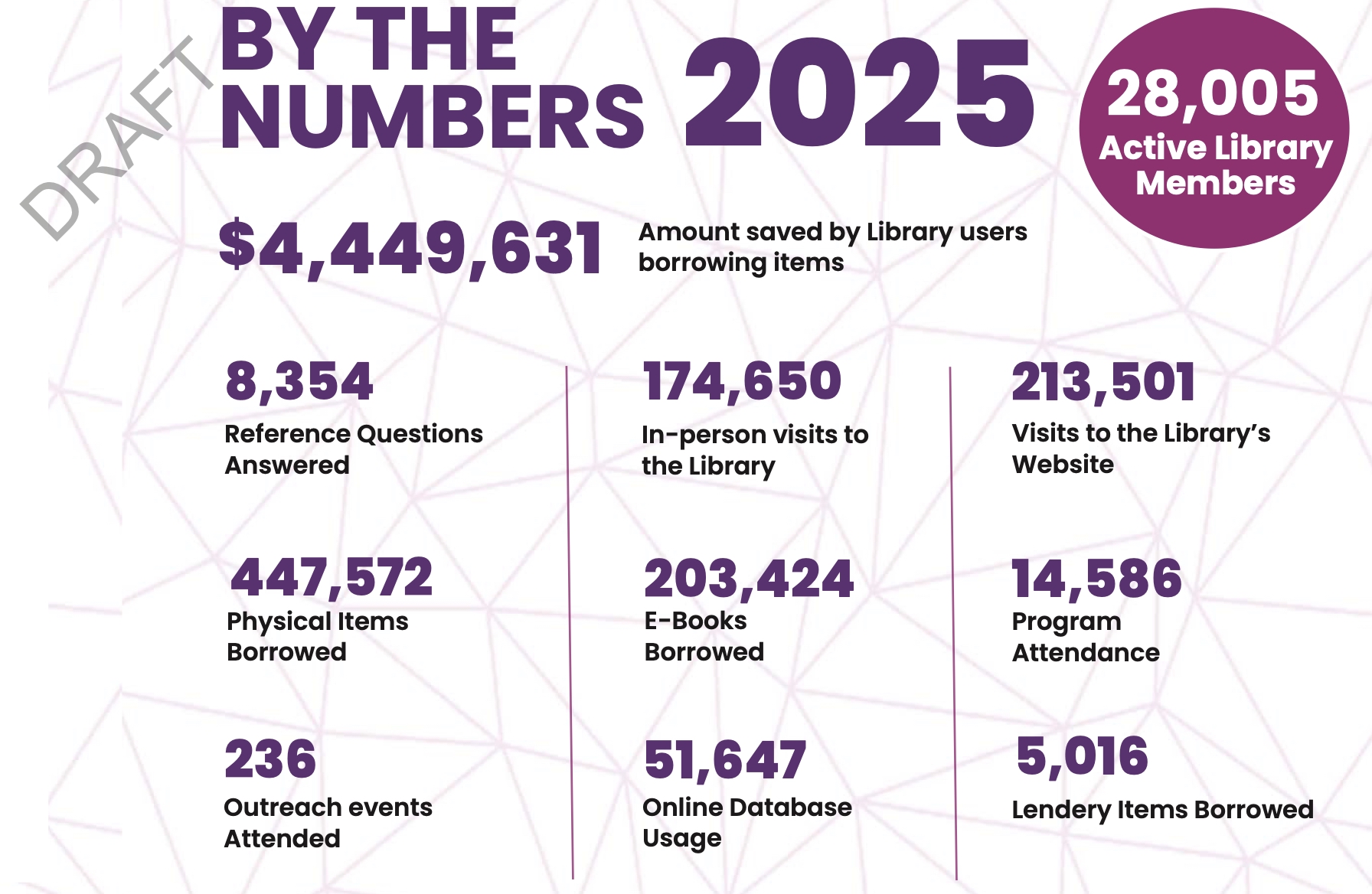
Last December, the Library Board responded to concerns about the range and quality of statistics coming out of the library by setting up a “metrics working group” chaired by Neila Poscente (formerly CEO of the Southlake Foundation). It will:
“explore and evaluate alternative methods of reporting library statistics and to incorporate these considerations into the next strategic planning process.”
The Working Group plans to report by the end of June this year with its findings being used to inform the library’s new strategic plan. The Board says it will look at practice across eight Ontario libraries (Vaughan is one) that are currently used as comparators when deciding the CEO’s salary which, last year, was $182,307.
Clarity
The Province’s old definition lacked clarity with even professional librarians interpreting it in myriad ways. As a result, comparing libraries on their performance, reach and outcomes was next to impossible.
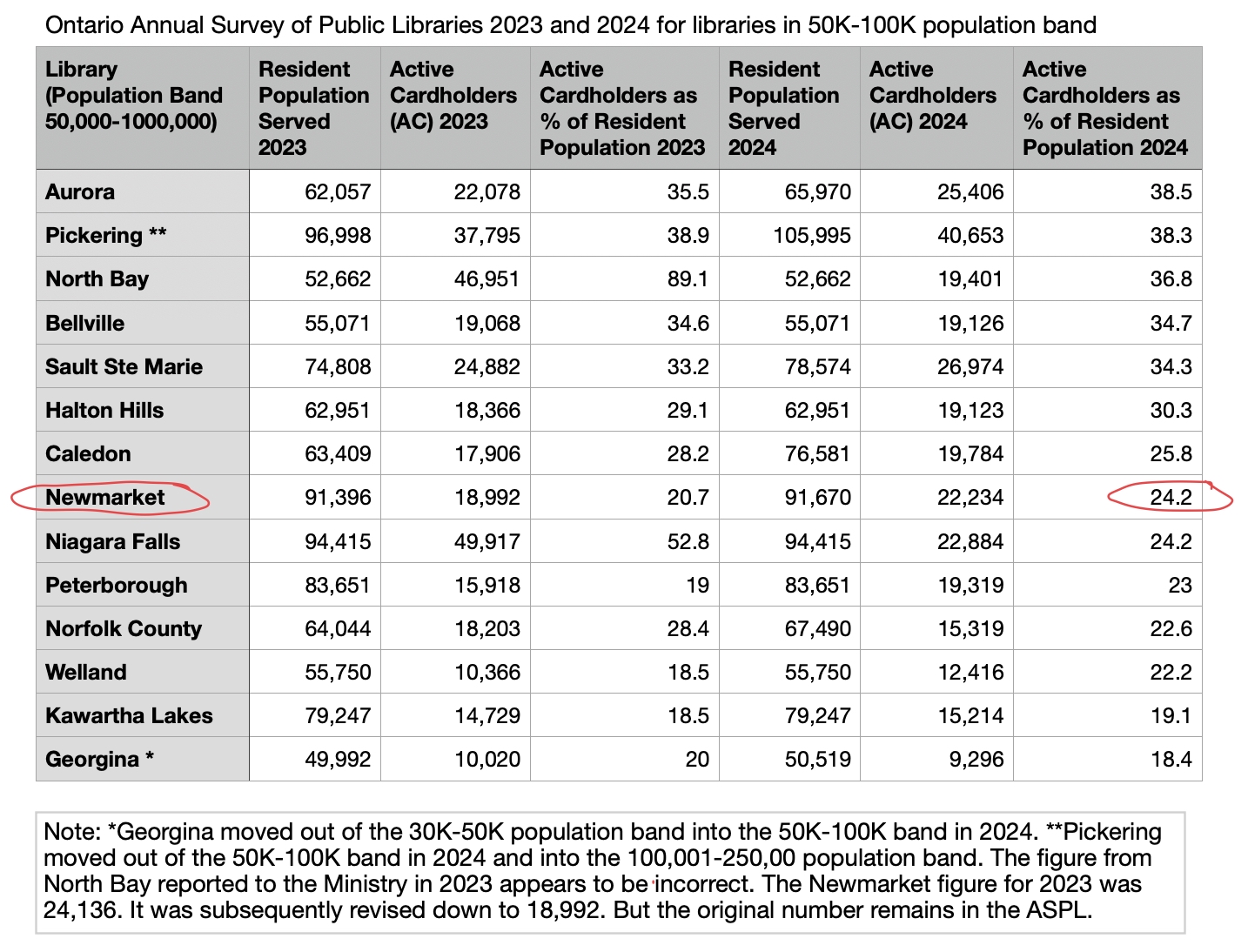
Our next-door neighbour, Aurora Public Library, has one branch like us but serves a smaller population. In 2024 (the last year for which figures are available) 38.5% of Aurora’s population were “active cardholders” compared with Newmarket’s 24.2%. Newmarket’s percentage for 2025 will be going up to 30.5% or thereabouts. (We don’t know the Town’s latest population figure.)
Headcounts only take us so far. More importantly, we need to understand how people use their library, what to measure and for what reason. This is what Newmarket’s Metrics Working Group is now focussed on.
This email address is being protected from spambots. You need JavaScript enabled to view it.
Update on 5 May 2026: From Newmarket Today: Newmarket Library Staff Raise Safety and Management Concerns.
Freedom of Information request:
Subject: Definition of "Active Cardholder" used for Annual Survey of Public Libraries
I am requesting access to records held by “X” Public Library that define or describe how the Library determines the number of "active library cardholders" reported in its most recent submission to Ontario's Annual Survey of Public Libraries. Specifically, I am requesting:
1. Any policy, procedure, guideline, manual, data dictionary, or internal definition that defines "active library cardholder" for reporting or statistical purposes;
2. Any documentation or instructions used by staff to calculate or extract the "active cardholder" figure from the library's integrated library system (ILS);
3. Any guidance documents, memos, or explanatory notes used by the “X” Public Library when completing the Annual Survey of Public Libraries that describe how "active cardholders" are identified or counted.
I am not requesting personal information about individual cardholders.